
During the second part of our vacation, we would visit a country that was new to all of us: a 5-night trip with two children, one 4 and a half years old and the other 15 months old. We considered a few points when choosing Norway, or more specifically its capital, Oslo: pleasant summer weather, a good airfare, and, above all, a kid-friendly country.
Our older son, Santiago, was somewhat used to sightseeing with his balance bike (read the article Sightseeing with kids: why balance bikes work), but he did not always want to go just a little farther to reach a church we wanted to see, for example. This time we would travel by plane and would not bring the bike. We would only bring a small stroller because of Franco, our youngest. How could we make exploring the city fun for Santiago? Actually, the question should have been: could the Oslo Seek and Find Bingo turn this trip into a great adventure for the whole family? This would be the chance to test the first city bingo created entirely by Fun Trip for Kids.
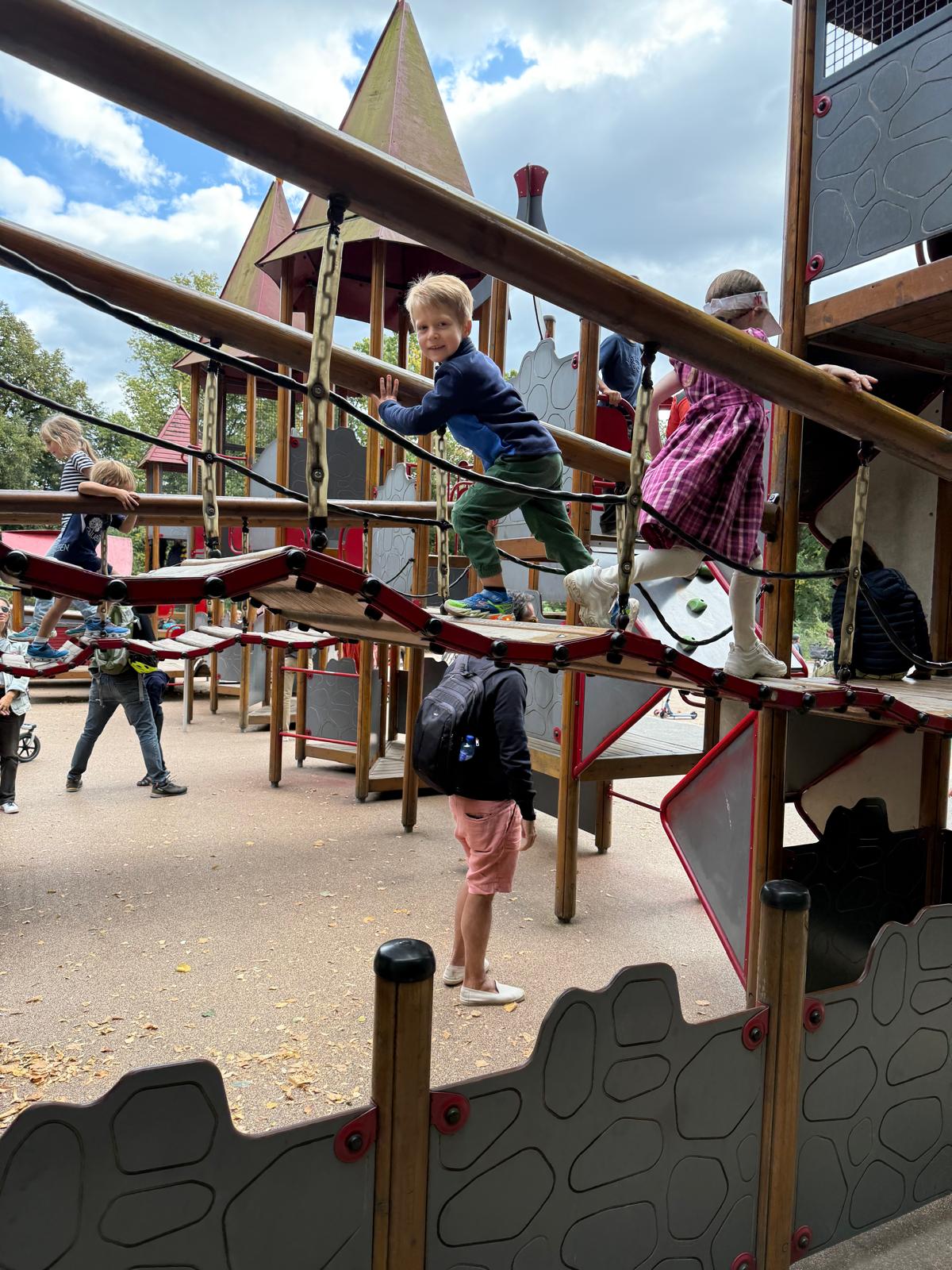
We visited the whole city by public transportation and on foot. We took the metro, tram, and bus. It may sound uncomfortable, but it enriches not only the experiences, but the adventure itself. And then there is all the learning involved in each means of transportation: knowing which route to take, buying the ticket, arriving on time, knowing how to behave on public transport, and not leaving anything behind. Walking through Oslo, we found playgrounds in unexpected places. I confess that sometimes we even had to avoid a few of them, while at other moments playgrounds that were not on the map came as a true blessing.
We planned a light itinerary for each day. We did not want to “check off” Oslo and its surroundings; we wanted to feel the city and live many experiences with our children. The first place we visited was Vigeland Park, a very different park full of huge sculptures. As we arrived, I showed Santiago the Seek and Find sheet and asked him to identify where we were. Bingo! He found the image that matched the park. My heart skipped a beat; the game had just passed its first test.
We spent a good amount of time in that park, where we also found a really nice playground. Then we took a tram and a bus to our next destination. “Mommy, I think I can mark another square in the game,” Santiago said, watching the trams while we waited for ours. I gave him the sheet and he marked the tram, then kept holding the sheet and looking around to see what else he could mark. “The bus!” he said excitedly. I explained the electric bus, the tram... and that is how we connect and learn together.
We visited the Fram Museum, which delighted everyone: one more “square” marked for Santiago. On the way back we took the ferry, and from it we could see Akershus Fortress. Part of the travel time was filled with the Seek and Find images, remembering the places we had passed and planning the next steps. It was amazing how he forgot to ask whether the outing was almost over or whether we were going to a playground. It was a much bigger surprise than I could have expected.
Back in central Oslo, we passed the National Museum, and Santi easily identified it on the bingo sheet. This time he did not ask a thousand questions about what was inside the building, because what he really wanted was to try a traditional ice cream we did not even know existed. To complete the day, we found a playground shaped like a lobster. Both the ice cream and the playground deserved to enter the revised edition of the game. And that was only the first day.
The next day we went to Drammen. What a beautiful city! It was market day, with varied stalls selling products, crafts, typical foods, and international food. There was a park with paid electronic rides and a large, very nice public playground. We walked a lot and missed Santiago’s balance bike, and he missed the game: “where is my foglio?” (sheet, in Italian).
On our third day of travel, we returned to central Oslo to see incredible buildings. I confess I had thought the Seek and Find drawings were a bit caricatured, but no: the buildings really do have fantastic architecture. As we walked, the game made Santiago observe everything around him and even explain to his brother what we were looking for. It was beautiful to experience: he walked because he wanted to discover what the next square on the sheet would be.
On the last day of the trip, we took the opportunity to visit Asker, a charming town, though with not much to do. It was a short outing; we came back early and enjoyed the playground near our accommodation.
Oslo is an incredible city. The places to discover, even without going inside, are beautiful, fascinating, and quite distinctive. The Seek and Find game connects the whole family with the outing and with one another. The other games are for breaks during the outing, for the end of the day back at the accommodation, or for remembering each place later, or even for getting to know the places we could not visit.
We came home with many photos. But our greatest memory was not a photograph, nor one of Oslo’s beautiful buildings or parks. It was our son’s little face with each discovery, with every “square” he marked. Without us knowing it, from that joy shared as a family, Fun Trip for Kids was also being born.
.jpeg)